
The S3 and S5 are the same sender with two different heads. Both measure level in exactly the same way and suit the same tanks and fluids — so the choice between them isn't about performance, it's about how the head fixes to your tank. Pick the one that matches the fitting you have or can make.
The short version
The S3 has a 1¼" BSP thread and screws in. The S5 has a 5-bolt flange on a standard SAE 5-hole pattern and bolts down. Same body, same float, same resistance options.
01The only real difference: the head
S3 — screw-in
1¼" BSP threaded head
Screws into a threaded boss in the top of the tank. Sealed by two O-rings under the head.
S5 — bolt-down
5-bolt SAE flange
Bolts down over a hole using the standard SAE 5-hole pattern. Sealed by a flat nitrile gasket.

02What's the same
- Both are made from 316 stainless steel.
- Both suit petrol (gasoline), diesel, fresh water, grey water and black water.
- Both use the same internal float and reed-switch measurement, so they read identically.
- Both are available in European or American resistance — match this to your gauge.
03Fitting the S3 (screw-in)
The S3 screws into a 1¼" BSP threaded boss in the top of the tank. It comes with two O-rings that locate in the underside of the head — screw it in and nip it tight, and the O-rings make a liquid-tight seal.
No thread in your tank? A fitting flange bolts to an existing hole and gives the S3 a threaded boss to screw into — its bolt pattern matches most standard hole layouts.
04Fitting the S5 (bolt-down)
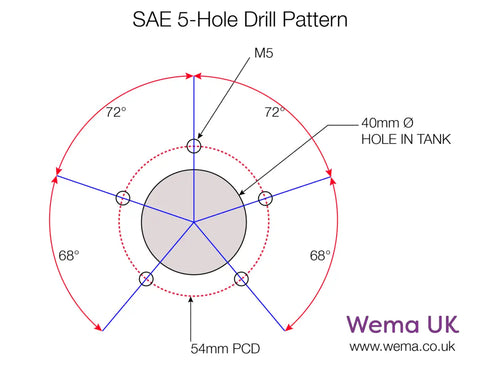
The S5 drops through a hole in the tank and is held by five bolts through the head into matching holes in the tank. It's supplied with one large flat nitrile gasket for a liquid-tight seal. The bolt layout is the standard SAE 5-hole drill pattern.
05Seals: petrol, ethanol and diesel
Both senders ship with nitrile seals as standard — two O-rings on the S3, a flat gasket on the S5 — and for diesel tanks nitrile is exactly right. Petrol is the exception: modern pump fuel contains far more ethanol than it used to (E10 and higher), and ethanol degrades nitrile over time, which can lead to a weeping seal.
06How senders are named
Wema senders are described by head type, resistance and length, in that order:
Example
S3-E400
S3 head · European resistance · 400 mm long.
Example
S5-A250
S5 head · American resistance · 250 mm long.
Length is measured from the top of the thread (S3) or the underside of the flange (S5) to the end of the stem. If you're not sure how long yours needs to be, see what length sender you need.
Ready to order?
Pick the head that fits your tank
Both come in a range of lengths and in European or American resistance. Choose the S3 if you have (or can make) a threaded fitting, or the S5 if you're bolting to a flat face.
07Common questions
Is the S3 or S5 better?
Neither — they measure identically. The right one is simply whichever head matches your tank: a threaded boss takes an S3, a flat face with a bored hole takes an S5.
Can I swap an S3 for an S5, or the other way round?
Only if you change the tank fitting to suit. They're not interchangeable in the same hole — an S3 needs a thread and an S5 needs the 5-bolt pattern. If you can't change the fitting, order the head type that matches what you've got.
Do both come in European and American resistance?
Yes. Match the resistance to your gauge — see European vs American resistance.
What fluids can they go in?
Petrol (gasoline), diesel, fresh water, grey water and black water. For anything else — oils, chemicals or unusually thick liquids — get in touch first.
Are the seals OK with E10 / ethanol petrol?
The standard nitrile seals are fine for diesel, but the ethanol in modern petrol degrades nitrile over time. For petrol tanks we recommend Viton O-rings and gaskets, which resist ethanol.
Not sure which sender you already have? See how to identify a replacement Wema sender, or contact us with a photo and we'll confirm it.