
If your tank has an old floating-arm style sender and the gauge has started reading erratically — sticking, jumping, or dropping out altogether — the sender is usually the culprit. The good news is that a Wema S3 replaces it directly, and it's built to last far longer.
01Why floating-arm senders give up
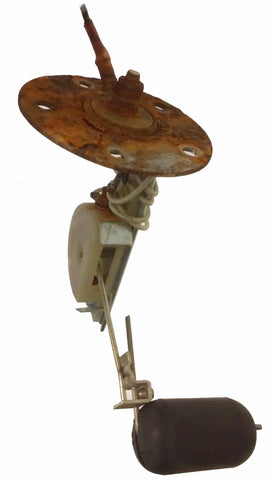
A floating-arm sender hangs a float on the end of a pivoting arm. As the level changes, the arm swings through an arc and a wiper slides across a resistance track to signal the gauge. That arc is the first problem: the float travels on a curve rather than straight up and down, so the reading is non-linear and never quite matches the true depth — and an awkwardly shaped tank only makes it worse.
The moving parts are the second problem. The arm, pivot, wiper and contacts all sit submerged in the fuel, in constant motion. They wear, stick and corrode, the wiper develops dead spots, the float can crack and sink, and the arm itself can fatigue and snap off into the tank. Long before that, the reading is highly sensitive to slosh — the float is only following one point on a surface that's pitching and rolling, so the needle jumps with every wave or corner.
The old sender
Floating arm
A float on a pivoting arm sweeps an arc, sliding a wiper across a resistance track — so the reading is non-linear and jumps with slosh. The arm, wiper and contacts sit in the fuel, where they wear, corrode, and can even snap off into the tank.
The replacement
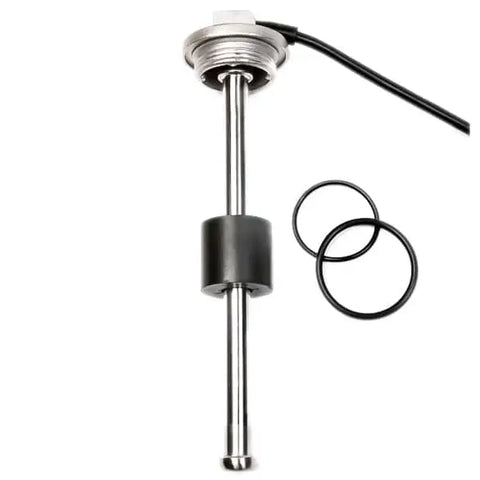
Wema S3
No arm, pivot or wiper. Double-insulated inside a sealed 316 stainless steel tube, with no mechanically moving parts — just a magnet in a float. As the level changes it closes sealed reed contacts in clean steps, for a steadier, more linear reading.
With no arm or linkage to seize and no exposed contacts to corrode, the S3 stands up to the constant movement of the liquid. It works in petrol (gasoline), diesel, fresh water, grey water and black water.
02Fitting an S3 in its place
Most floating-arm senders bolt to a five-hole SAE drill pattern. The FL-2 flange bolts straight onto that same pattern, and the S3 sender screws into the flange — so there's no new hole to cut.
Fitting is then as simple as screwing in the sender and joining its two wires to the gauge. One thing to note: the flange has a central up-stand, so it needs small-headed M5 screws that clear it — worth adding to your order alongside the flange.
03Matching your existing gauge
For the gauge to read correctly, the S3 has to match its resistance range. We can supply the sender to suit your existing gauge, whoever made it — you just need to know whether it's a European or American range. If you're not sure, European vs American resistance explains how to tell them apart, and how to identify a replacement sender walks through what to check.
You'll also need the right length for the tank — if you're not sure how long yours should be, see what length sender you need.
Make the swap
Wema S3 sender
A direct, longer-lasting replacement for an old floating-arm sender — fitted with an FL-2 flange onto the existing bolt pattern.
04Common questions
Will the S3 fit my old floating-arm sender's holes?
In most cases, yes. Floating-arm senders usually sit on a five-hole SAE pattern; the FL-2 flange bolts to that pattern and the S3 screws into the flange, so you won't need to cut a new hole.
Will it work with my existing gauge?
Yes, provided the sender matches the gauge's resistance range. We can supply the S3 to suit your gauge whatever the make — see European vs American resistance to work out which you need.
Do I need special screws for the flange?
Small-headed M5 screws, yes — the flange has a central up-stand and standard heads can catch on it. Add a set of M5 screws when you order the flange.
What can the S3 measure?
Petrol (gasoline), diesel, fresh water, grey water and black water.
Not certain what you're replacing? See how to identify a replacement Wema sender, or get in touch and we'll help you choose the right sender and flange.