
Getting the length right matters for two reasons: the sender needs to reach far enough down to read the tank accurately, but it must never rest on the bottom. A sender touching the base picks up every knock and vibration through the tank, which shortens its life. The job is to fill the depth while leaving a small gap at the bottom.
The short version
Measure from the top face of the tank to the inside bottom, then subtract a clearance: about 10 mm in a rigid tank, 25 mm in a flexing plastic tank, and at least 50 mm in a holding (black-water) tank.
01Work out the length
Measure the internal depth — from the top face of the tank straight down to the inside bottom — then take off a clearance to suit the tank:
Rigid tank
Depth − 10 mm
Metal or solid tanks that don't flex. A small gap keeps the stem clear of the base.
Flexing plastic tank
Depth − 25 mm
Plastic tanks move under load. The extra gap means it never touches even when the tank flexes.
Holding / black-water tank
Depth − 50 mm
Solids settle and build up at the bottom. A larger gap keeps the sender out of the sludge.
Static storage tank
Add a reserve if needed
Bottom clearance isn't operationally critical, but you may want to stop short to keep a reserve below the reading.
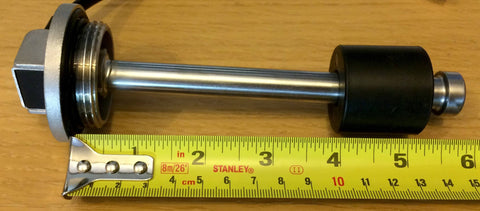
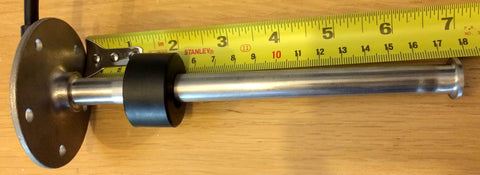
02How to measure an S3 or S5
Length is taken from the mounting point to the end of the stem — but the mounting point differs between the two heads.
Not sure which head you have? See the difference between the S3 and S5.
03Standard lengths and custom orders
Our standard range covers the vast majority of tanks. Measure your depth, take off the clearance above, and choose the nearest standard length at or below that figure — for a single sender that's almost always the quickest and best-value option.
We can also make senders to a non-standard length and calibrate them to the shape of a tank. This is straightforward and cost-effective on a trade or volume order. For a one-off, a bespoke sender is possible but carries a higher unit cost, so a standard length is usually the better choice for a single fitting.
If a standard length can't cover your tank, or you're ordering in quantity, get in touch and we'll work out the best option with you.
04Using your sender with NMEA 2000
Any standard or custom sender can be plugged into an NMEA 2000 signal converter to put its reading onto a digital network. See how an NMEA 2000 network works if you're planning a digital system.
Ready to order?
Choose the nearest standard length
Standard senders cover almost every tank off the shelf. Measure, subtract the clearance, and pick the closest length at or below it — or ask us if you're not sure.
05Common questions
How big a gap should I leave at the bottom?
About 10 mm in a rigid tank, 25 mm in a flexing plastic tank, and at least 50 mm in a holding (black-water) tank where sludge settles. The key point is that the sender should never rest on the bottom.
What happens if the sender is too long?
If it touches the bottom, vibration carries up through the stem and shortens its life. Too long is worse than slightly too short — always leave a clearance.
Can you make a sender to fit an odd tank?
For a single sender, the nearest standard length below your measurement is usually the most cost-effective choice. Custom and calibrated senders are available and make good sense on a trade or volume order; for a one-off they carry a higher unit price. Get in touch if a standard length won't cover your tank, or if you're ordering in quantity.
How do I measure the sender itself?
For an S3 or S3H, measure from the top of the thread to the bottom of the stem. For an S5, measure from the underside of the flange to the bottom of the stem.
Need to identify what you already have first? See how to identify a replacement Wema sender, or get in touch with your tank dimensions.