
NMEA 2000 is the communication standard that connects marine electronics together. Instead of running a separate cable between every pair of instruments, every device taps into a single shared cable — the backbone — and once it's connected, your displays, sensors, engine data, GPS and tank senders can all read each other's information automatically.
01The standard, in plain terms
NMEA 2000 is a standardised network built for the marine environment, where reliable data has to survive vibration, damp and electrical noise. It carries the signals from every connected device over one multi-drop cable, so a single display can show information gathered from right across the boat. Because the wiring is shared rather than point-to-point, a NMEA 2000 system means far less cable, fewer connections to fail, and a tidier installation that's easier to maintain.
A single NMEA 2000 network can carry up to 50 devices — from chartplotters and instruments to engine interfaces and tank senders — all talking on the same backbone.

02How a NMEA 2000 network is built
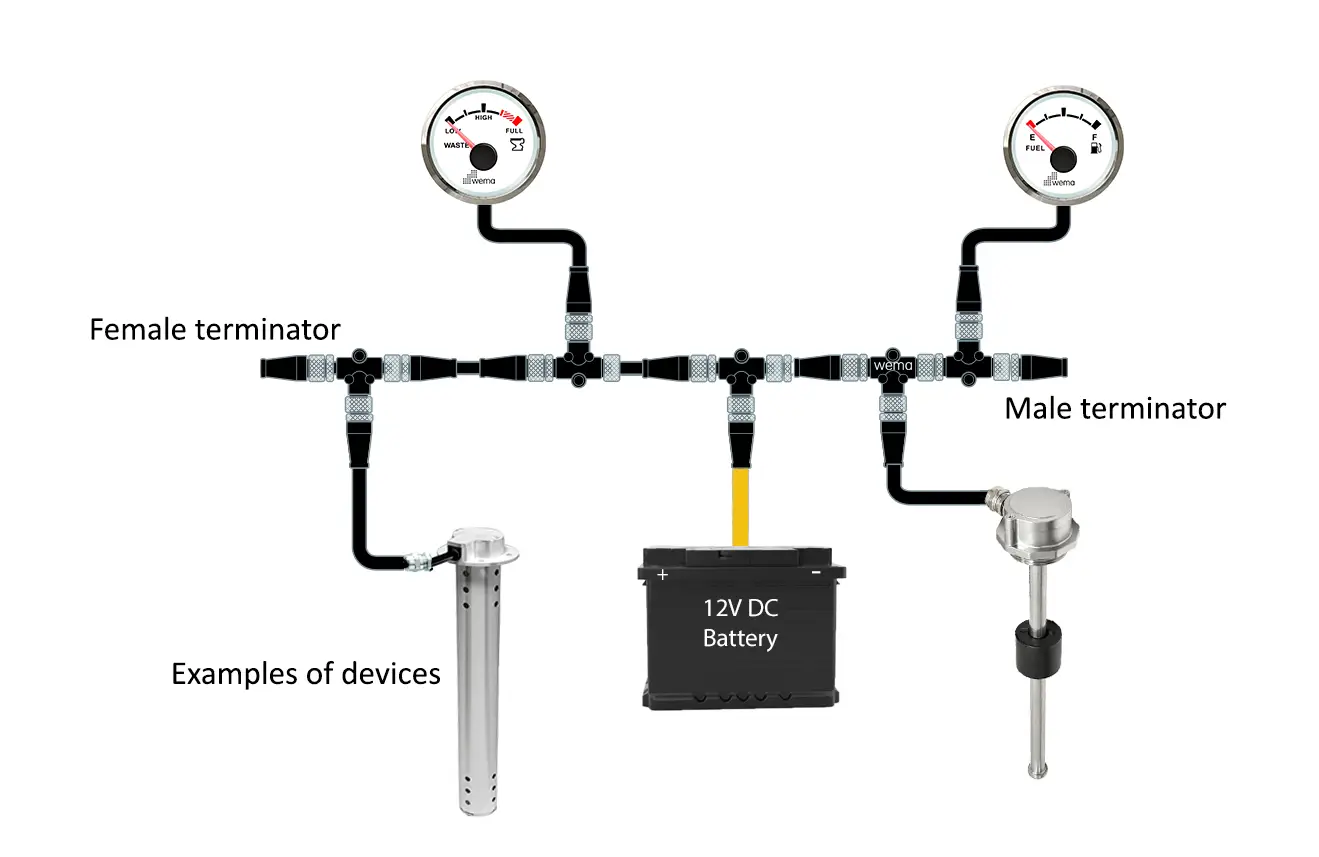
Every NMEA 2000 network has the same simple shape — a backbone running the length of the boat, with short cables branching off it to each device:
- The backbone is the main trunk cable. Data and power both travel along it.
- T-connectors clip into the backbone wherever you want to attach a device.
- Drop cables run from each T-connector to a device.
- Terminators — one at each end of the backbone — stop signal reflections and keep communication clean. You need exactly two.
- Power is fed in through one or more power cables tapped into the backbone, positioned to suit the number and location of devices.
It's genuinely plug-and-play. Adding a new instrument is as simple as clipping in another T-connector and a drop cable — the device then starts communicating with everything else on the network automatically. That makes a NMEA 2000 system easy to expand or modify as your needs change.
Wema's NMEA 2000 cables and connectors use the micro standard, allowing a backbone of up to 100 metres, with each drop cable up to 6 metres and a combined total of 72 metres across all drop cables — enough flexibility for everything from a small craft to a larger commercial vessel.
03How the data moves
NMEA 2000 runs at 250 kilobits per second, fast enough for real-time updates between sensors, displays and every other NMEA 2000 device — which is what makes it dependable for navigation, safety and engine monitoring.
Electrically, NMEA 2000 is built on CAN bus, the same robust technology used in road vehicles and engines, and its higher-level message format is based on the SAE J1939 standard, adapted with messages specific to the marine environment. That heritage is why the network is so reliable: it borrows from protocols already proven in demanding industrial use.
04Adding older analogue sensors
If your boat still has analogue senders, you don't have to replace them to get onto the network. An analogue-to-digital converter reads the analogue signal and puts it onto the NMEA 2000 backbone, so older equipment can sit alongside modern digital instruments and feed the same displays.
Build or extend a network
Certified NMEA 2000 products
Backbone and drop cables, T-connectors, terminators, power cables, converters and certified instruments — everything you need to put a NMEA 2000 network together.
05Go deeper
This page is the overview. For the practical detail, these guides cover each part of a NMEA 2000 system:
- The backbone-and-drop layout and how a network works, step by step.
- The advantages of NMEA 2000 over older wiring.
- How to plan and design a NMEA 2000 network before you buy.
- Setting type and instance values so your displays tell identical devices apart.
06Common questions
What is NMEA 2000?
NMEA 2000 is the standard digital network for marine electronics. Every certified device connects to a single backbone cable and shares its data with the rest of the network, so one display can show information from instruments all over the boat.
How many devices can a NMEA 2000 network have?
Up to 50 devices on a single backbone under typical conditions. In practice the power budget is usually the real limit before you reach the device count.
How long can the backbone and drop cables be?
With micro cable, the backbone can run up to 100 metres. Each drop cable can be up to 6 metres, and all drop cables combined up to 72 metres.
Can I put older analogue sensors on a NMEA 2000 network?
Yes. An analogue-to-digital converter reads the analogue signal and places it on the backbone, so legacy equipment can share the network with digital devices.
Can I mix different makes of equipment?
Yes — NMEA 2000 is an open standard, so certified devices from different makers share data correctly. Some use a differently shaped connector, so an adapter may be needed, but the signals are the same.
Planning a NMEA 2000 system and not sure what you need? Browse the certified NMEA 2000 range, or get in touch and we'll help you build it.